Emails to send users who went quiet or cancelled (templates)
Short, personal emails that get honest answers from users who stopped using your app or SaaS. Templates for quiet users, cancellations and former customers.
Short answer: send a short plain-text email from a real person, ask what got in the way, and make it easy to answer in one line. Don’t lead with a discount or a feature list. Send it within a few days of someone going quiet or cancelling, while they still remember why.
One founder in our research emailed 20 users who had left, got a single reply, rebuilt the offer around it and saw results within hours of relaunching. Replies are rare, so each one is worth a lot.
Rules that make these emails work
- Plain text, from a person. It should look like an email from you, not a campaign.
- One clear ask. “What got in the way?” beats a five-question survey.
- Make one line enough. Say a short reply helps.
- No guilt, no pressure. They don’t owe you anything.
- Reply to every answer. Thank them, and tell them if you fix it.
Template: user went quiet after signing up
Subject: Quick question about {product}

Hi {first name},

I noticed you signed up for {product} last week but haven’t been back.
Did something get in the way? Even a one-line reply helps me fix it.

Thanks,
{your name}
{role}, {product}
Template: active user stopped using it
Subject: Did {product} stop being useful?

Hi {first name},

You used {product} a lot in {month}, then stopped. Did something break,
or did your needs change? I’d really like to know, good or bad.

{your name}
Template: just cancelled
Subject: Sorry to see you go

Hi {first name},

Thanks for trying {product}. Your account stays available until {date}.
If there was one thing that would have kept you, what was it?
I read every reply.

{your name}
Template: after you fixed what they asked for
Subject: You asked, we fixed it

Hi {first name},

You told us {problem} in {month}. That’s fixed now, thanks to you.
If you want to give {product} another try, your account is still here.

{your name}
When to send them
| Situation | When |
|---|---|
| Signed up, never came back | Two to three days after sign-up |
| Regular user went quiet | After a week or two without use |
| Cancelled | Same day or the next |
| You fixed their reason | As soon as it ships |
Template: free user who never upgraded
Subject: Was {product} useful?

Hi {first name},

You’ve been using the free version of {product} for a while.
What would make the paid plan worth it for you? Or is the free
version all you need? Either answer helps.

{your name}
Template: app user, if you have their email
Subject: Did something go wrong in {app}?

Hi {first name},

You haven’t opened {app} in a couple of weeks. If something broke
or annoyed you, I’d really like to know. Just hit reply.

{your name}, who makes {app}
Sending them without hurting your email reputation
- Send from a real mailbox on your own domain, not a no-reply address.
- Send in small batches over a few days rather than all at once.
- Only email people who signed up for your product. Never buy or scrape lists.
- Include a simple way to opt out, such as “reply ‘no’ and I won’t email again”.
- Plain text gets more replies and is less likely to land in spam than heavy designs.
What replies to expect
Most people won’t answer. The ones who do tend to fall into a few groups: something broke, they didn’t understand how to use it, it didn’t fit their need, or their situation changed. Write each reply down in their words. After ten or so you’ll usually see the same two or three reasons, and those are worth more than any dashboard.
Answering the replies
- Something broke: apologise, ask for details if needed, tell them when it’s fixed.
- Didn’t understand it: offer a quick call or a short walkthrough.
- Didn’t fit their need: thank them and ask what they use instead.
- Situation changed: thank them; they may come back later.
Subject lines that get opened
- “Quick question about {product}”
- “Did something go wrong?”
- “{first name}, one thing I’d like to know”
- “Sorry to see you go”
Avoid subject lines that sound like marketing (“We miss you!”, “Come back for 50% off”). They get ignored or marked as spam, and they don’t lead to honest answers.
Mistakes to avoid
- Several questions in one email. Pick the one you most need answered.
- Links to a survey. Asking for a reply is easier than asking for a click and a form.
- Sending from a no-reply address. It tells people you don’t want to hear back.
- Arguing with the answer. If they say it was too expensive, thank them. Don’t explain why it isn’t.
- Sending it weeks later. Memory fades fast; so does willingness to help.
Catch them before they need this email
These emails recover a few people. Feedback during use prevents many more from leaving. Most people who quit had a moment where something didn’t work; if they could have told you then, in a sentence, you might never have needed to write.
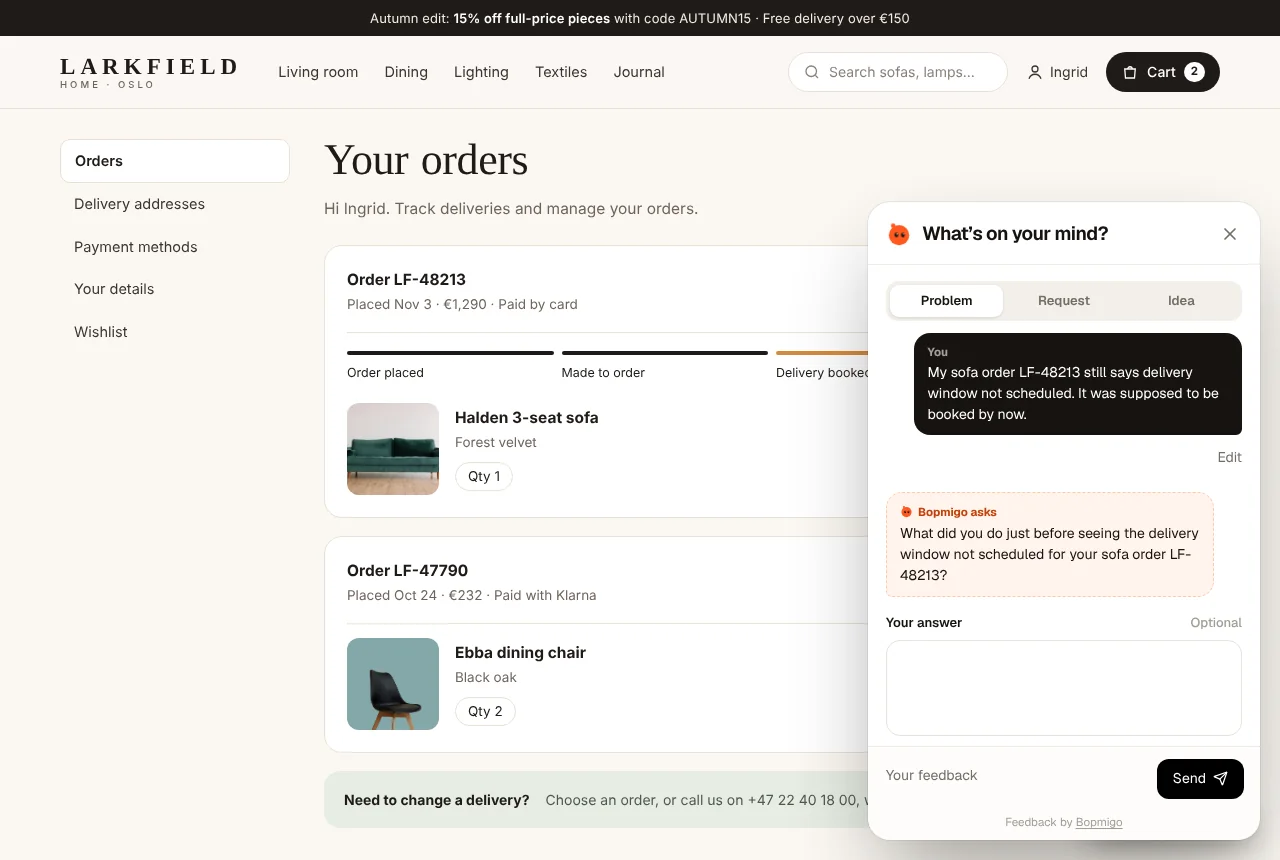
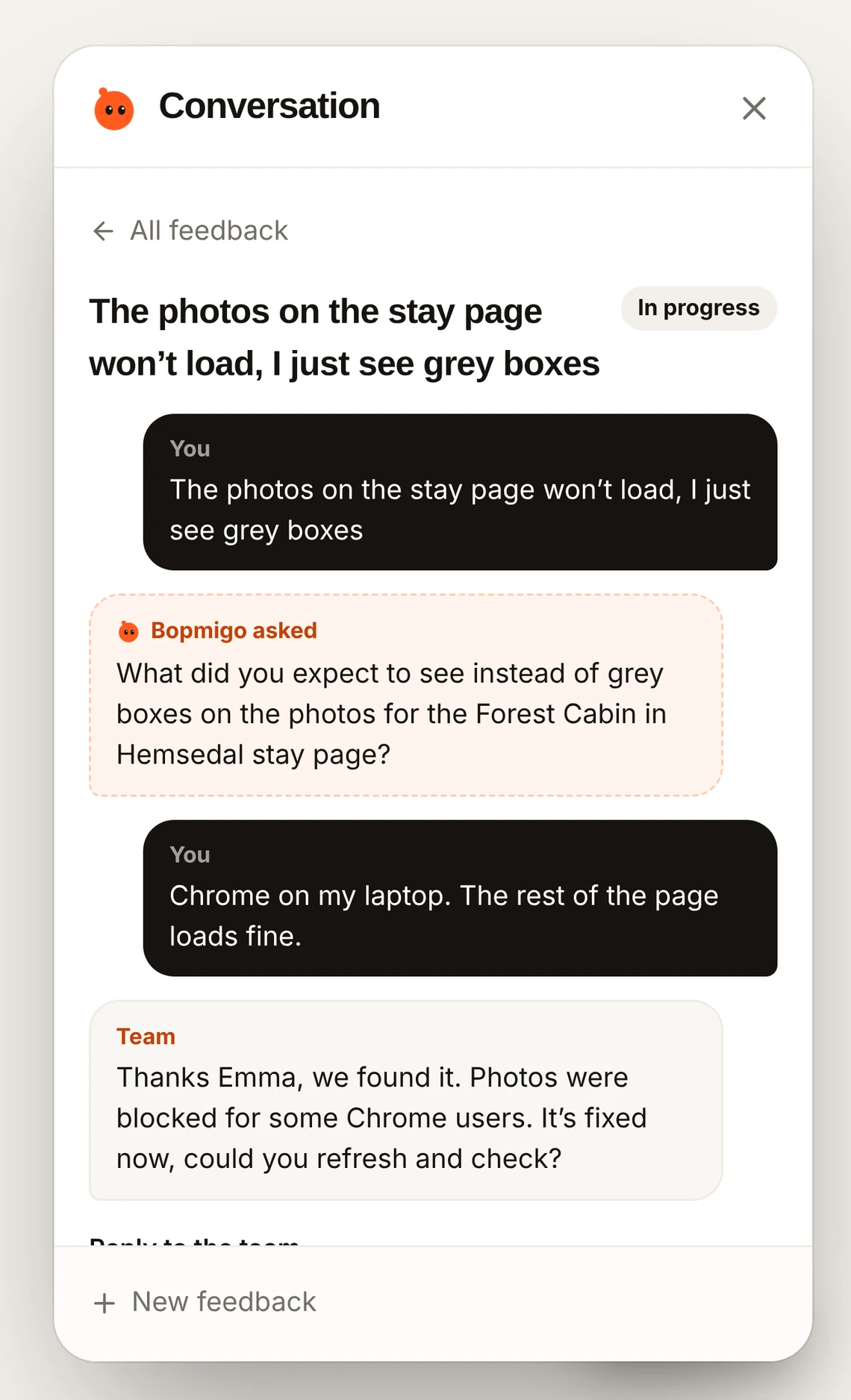
With Bopmigo, people report from inside your website, web app or app in a line, with the screen and device included, and your reply reaches them where they reported. If you pass in who is signed in, each report shows the customer, so you know exactly who to follow up with.