Card-required vs no-card free trials: what changes and how to choose
Asking for a card changes who signs up, not just how many pay. How each option affects sign-ups, conversion and feedback, and how to decide for your product.
Short answer: a card-required trial usually brings fewer sign-ups but a higher share of paying customers, because only people already fairly sure start it. A no-card trial brings more sign-ups and more people who never pay, but also more people to learn from. Choose based on what you need most right now: if you need revenue and have clear demand, ask for a card; if you’re still learning what people want, don’t, and use the extra trial users to find out what’s missing.
Founders in our research tried both. One switched to a card-required trial because sign-ups weren’t converting and asked whether it would help; another reported that making the card required almost doubled sales. Neither result transfers automatically to your product, but the trade-off is consistent.
What each option changes
| Card required | No card | |
|---|---|---|
| Sign-ups | Fewer | More |
| Share who pay | Higher | Lower |
| Who starts a trial | People already close to buying | Curious visitors and real buyers mixed |
| What you learn | From people likely to pay | From a wider group, including why people don’t buy |
| Risk | Losing good customers who won’t enter a card yet | Spending time on people who were never going to pay |
| Support load | Billing questions and refund requests | More setup questions from casual users |
When to ask for a card
- You have steady demand and need to know who is serious.
- Your product has real costs per user during the trial.
- People already understand what your product does before signing up.
- You can make cancelling easy and clear, so asking for a card doesn’t feel like a trap.
When not to
- You’re early and still learning what people need.
- Your audience is wary of subscriptions, or the price is high relative to what they know about you.
- You rely on people discovering value during use rather than knowing it in advance.
Whatever you choose, ask why
The trial type changes your numbers; it doesn’t tell you why people pay or don’t. Ask trial users what’s missing during the trial, and ask people who didn’t continue what would have made it worth it. If you switch to card-required, ask people who left at the card step what made them hesitate.
How to run the switch as a test
- 1
Write down your current numbers
Trials started per week, share that paid, and revenue per visitor to the sign-up page.
- 2
Switch for a fixed period
Long enough to see a reasonable number of trials end. With low traffic, that may be a month or more.
- 3
Compare revenue per visitor, not just conversion
Card-required almost always raises the share who pay. The question is whether total revenue from the same traffic goes up.
- 4
Watch refunds and complaints
If people forget to cancel and ask for refunds, the higher conversion isn’t real.
Making a card-required trial feel fair
- Say clearly on the sign-up page when the first charge happens.
- Send a reminder a couple of days before the trial ends.
- Make cancelling a few clicks, without a phone call or a maze.
- Refund people who clearly forgot, quickly and without argument.
Other options in between
| Option | How it works |
|---|---|
| Free plan plus paid trial | Free forever with limits, plus a trial of the paid features |
| Card at the end of the trial | No card to start, ask for it in the last days with a reminder |
| Usage-based trial | Free until a number of actions, then pay |
| Money-back guarantee | Pay upfront, refund if not happy within a set period |
Questions to ask yourself before switching
- Do I have enough traffic that losing some sign-ups won’t leave me with too few trials to learn from?
- Do people understand what the product does before they reach the sign-up page?
- Is cancelling as easy as signing up?
- Am I switching because of evidence, or because a founder online said it doubled their sales?
If the answer to the first two is no, a no-card trial with good follow-up is usually the better choice for now. You can always switch later, once you know what makes people pay.
What Bopmigo does
For what it’s worth, Bopmigo’s own trial is 7 days with no card, because the product is quick to set up and we want as many people as possible to see a real report arrive. When the trial ends without a plan, the inbox pauses and everything is kept, so people can pick a plan and carry on where they left off.
How Bopmigo helps you learn from either kind of trial
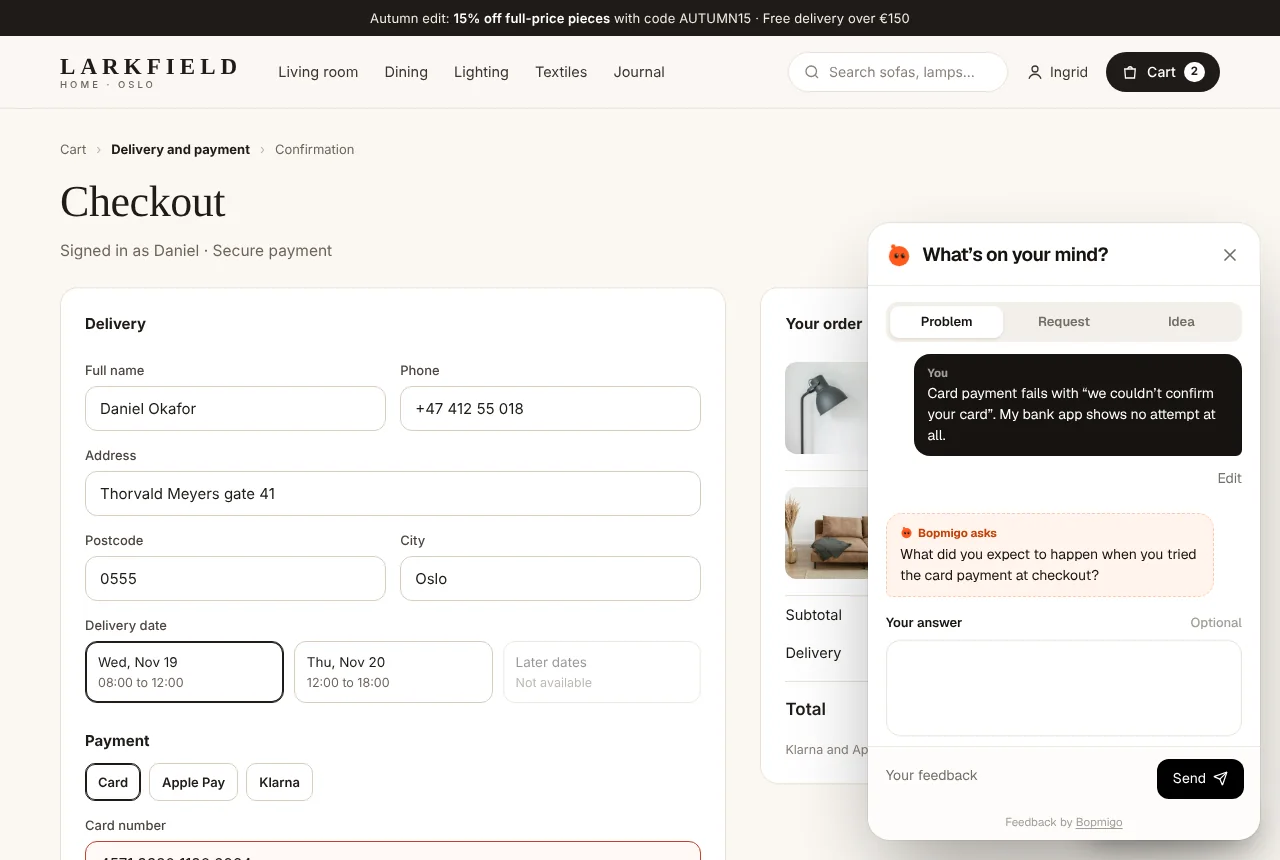
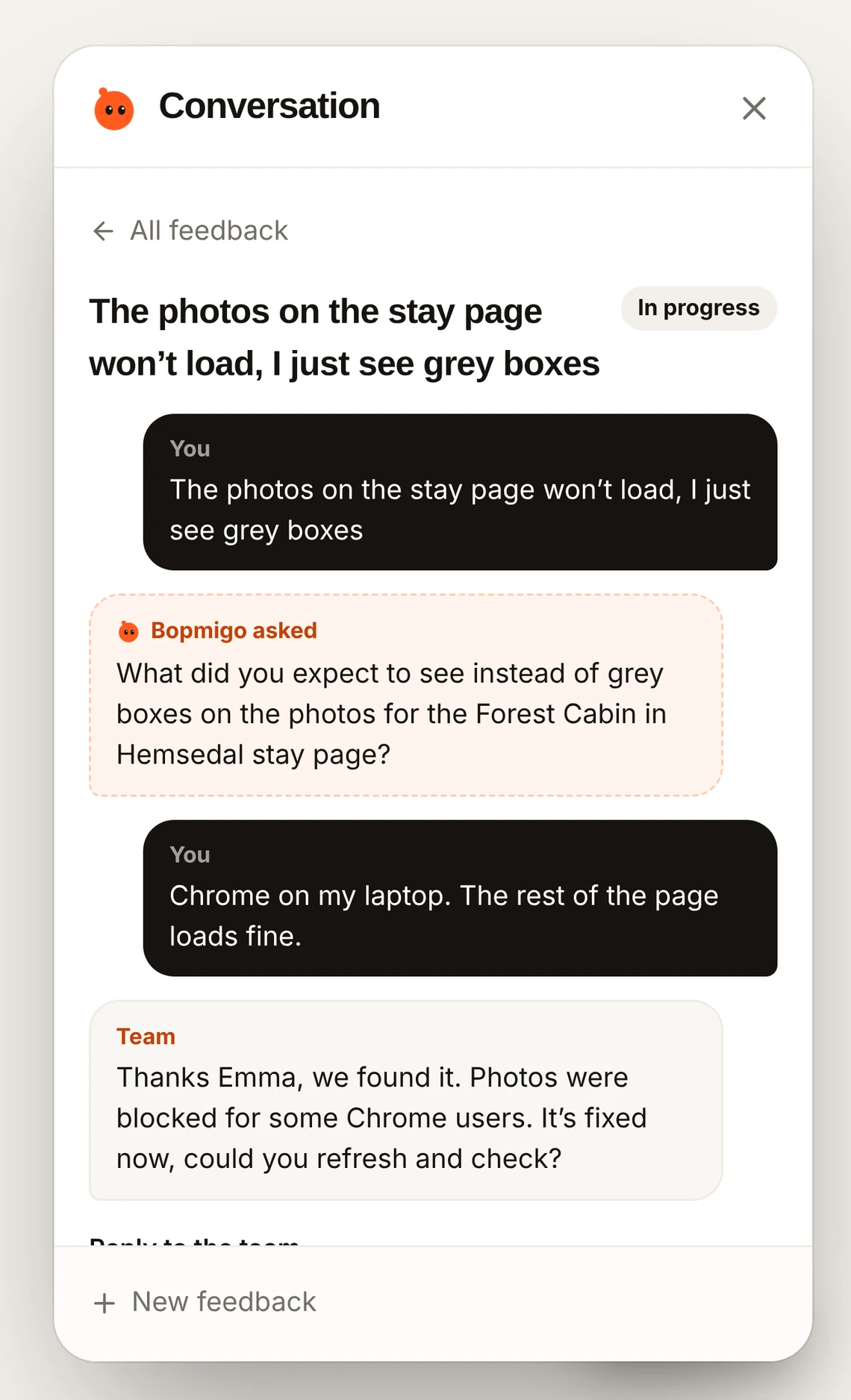
Bopmigo gives trial users a way to tell you what’s confusing or missing from inside your product, in a sentence, with the screen included. With a no-card trial, that turns a large group of casual users into a steady source of insight. With a card-required trial, it helps you keep the serious users you worked hard to get. You reply where they asked, while they’re still deciding.