Why trial users don’t convert to paid (and how to find out which reason is yours)
Trials start, nobody pays. The usual reasons, how to tell them apart with a few numbers, and how to ask trial users what stopped them while they are still in the product.
Short answer: trial users usually don’t pay for one of five reasons: they never reached the result they came for, the trial ended before they did, something broke, the price didn’t match the value they saw, or they were never a real buyer. Look at what trial users actually did, then ask the ones still in their trial what’s missing. The answers point at different fixes, so don’t change the price or the trial length until you know which reason is yours. This guide is for products with a time-limited trial. If people sign up but nobody pays at all, start with sign-ups but no paying customers. If you have a free plan instead of a trial, see why free users never upgrade.
This was the single most common money problem in the founder posts we read between September and November 2026. Founders posted numbers like “26 trials, 1 paying customer”, “18 trial users, 0 paying” and “10 trials in and zero paid” and asked whether to change ads, pricing or the trial. The honest answer is almost always: ask the people who didn’t pay first.
The five reasons, and how to spot each
| Reason | What you’ll see | Usual fix |
|---|---|---|
| Never reached the main result | Trial users rarely complete the core action | Shorten setup, guide the first result, help them personally |
| Ran out of time | Users were active near the end but hadn’t finished setting up | Longer trial, or a trial that starts at first real use |
| Something broke | Activity stops suddenly after an error or a specific screen | Fix the bug, and make it easy to report problems during the trial |
| Price vs value mismatch | Users completed the core action but didn’t upgrade | Show the value they got, test plans, ask what they’d pay for |
| Not a real buyer | Sign-ups from curiosity, students, competitors | Better targeting, a question at sign-up about what they need |
Three numbers to check first
- Share of trials that complete the core action. If most never do, the problem is before pricing.
- When trial users stop being active. A drop on day one is a first-session problem; a drop near the end is a value or price problem.
- Where people who did pay came from. Compare their path with those who didn’t.
Ask during the trial, not after
After a trial expires, people have moved on and rarely answer. During the trial they’re still deciding, and a good question helps them decide.
- On day two or three, a short personal email: “What are you hoping to do with {product}? Anything in the way?”
- A feedback option inside the product, so “I can’t figure out how to…” becomes a message you can answer.
- Near the end of the trial: “Is anything stopping you from continuing?” with a reply from a real person.
- For people who don’t upgrade: a short plain email asking what would have made it worth paying for.
Fixes that help most trials
- Get people to the first useful result in their first session.
- Offer to set it up with them. For B2B products, a short call can matter more than any email sequence.
- Show what they’ve achieved during the trial before asking them to pay.
- Remove anything that blocks the main result in the trial plan.
- Make the upgrade screen clear: price, what’s included, how to cancel.
A worked example
Say a B2B tool has 30 trials in a month and 1 converts. The founder’s instinct is to lower the price. Before doing that, they check three things:
- How many trials completed the core action? 6 of 30. So 24 people never got the result the product exists for. Price isn’t their problem.
- Where did the 24 stop? 15 stopped at the step where they had to connect another tool. That step is the real wall.
- What did the 6 who got the result do? 1 paid, 5 didn’t. Emailing those 5 brings back 2 answers: one needs a team plan, one found it too expensive for occasional use.
Now there are clear, separate fixes: make the connection step easier (or optional at first), add a team option, and maybe a lower plan for occasional users. Cutting the price for everyone would have fixed none of the first problem.
What founders tried, and what it tells you
| What they changed | What it tests |
|---|---|
| Required a card for the trial | Whether the problem was unserious sign-ups |
| Made the trial longer | Whether people ran out of time |
| Lowered the price | Whether price was the blocker for people who saw value |
| Spent more on ads | Nothing about conversion; it brings more of the same visitors |
| Talked to trial users | Which of the above is actually true |
In the posts we read, founders who changed several of these at once often couldn’t tell what worked. Change one thing, wait for enough trials to judge it, and keep asking.
A trial checklist
- Welcome email from a person, with a single next step.
- A visible way to ask questions or report problems inside the product.
- A check-in a few days in: “anything in the way?”
- A reminder before the trial ends, with what they achieved so far.
- A clear upgrade page: price, what’s included, how to cancel.
- A follow-up for people who don’t upgrade, asking what would have made it worth it.
What not to do
- Don’t cut the price first. It’s the easiest change and the least likely to fix a product that people haven’t used yet.
- Don’t add features to win trials. More features usually make the first session harder, not easier.
- Don’t send long automated sequences nobody reads. A few personal emails beat ten automated ones.
- Don’t judge with too few trials. Ten trials is a story, not a statistic. Read them individually.
How Bopmigo helps you hear from trial users
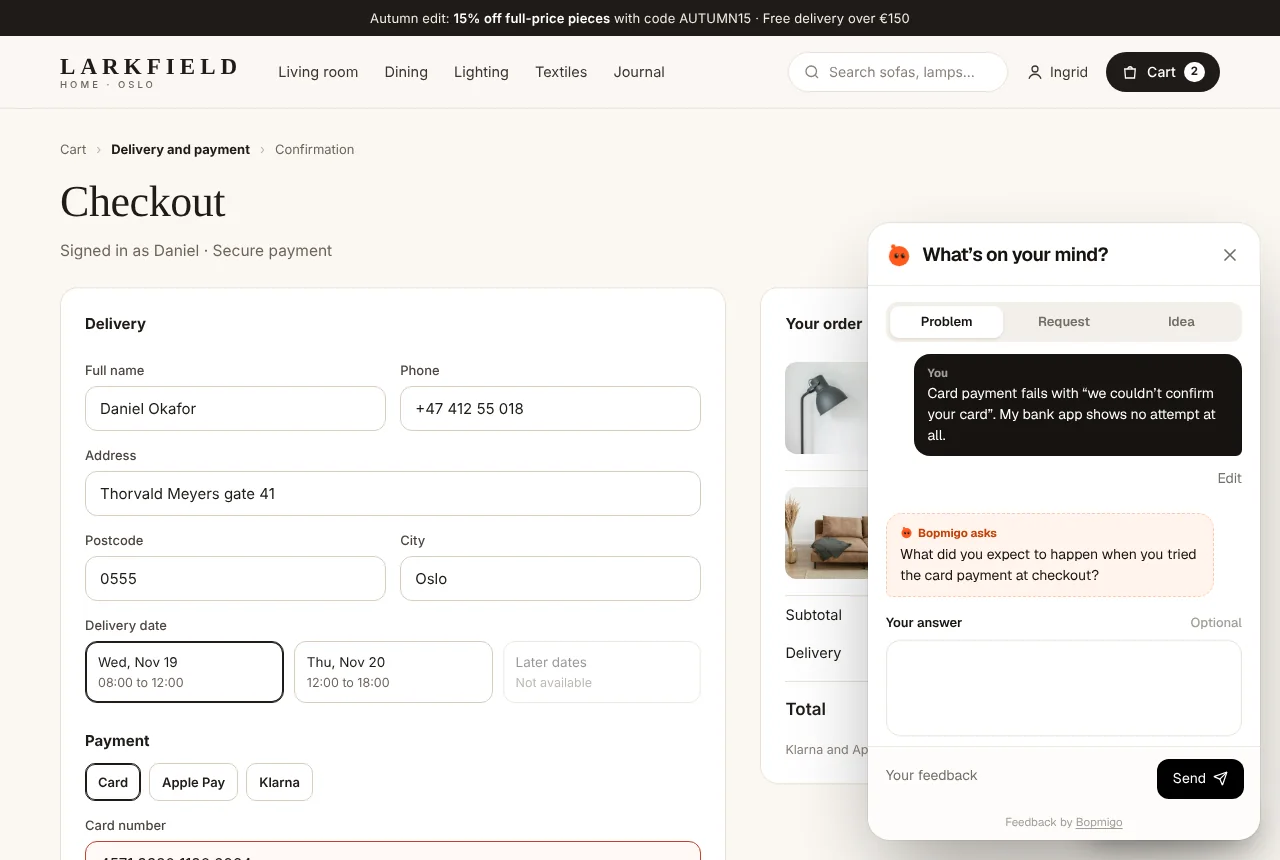
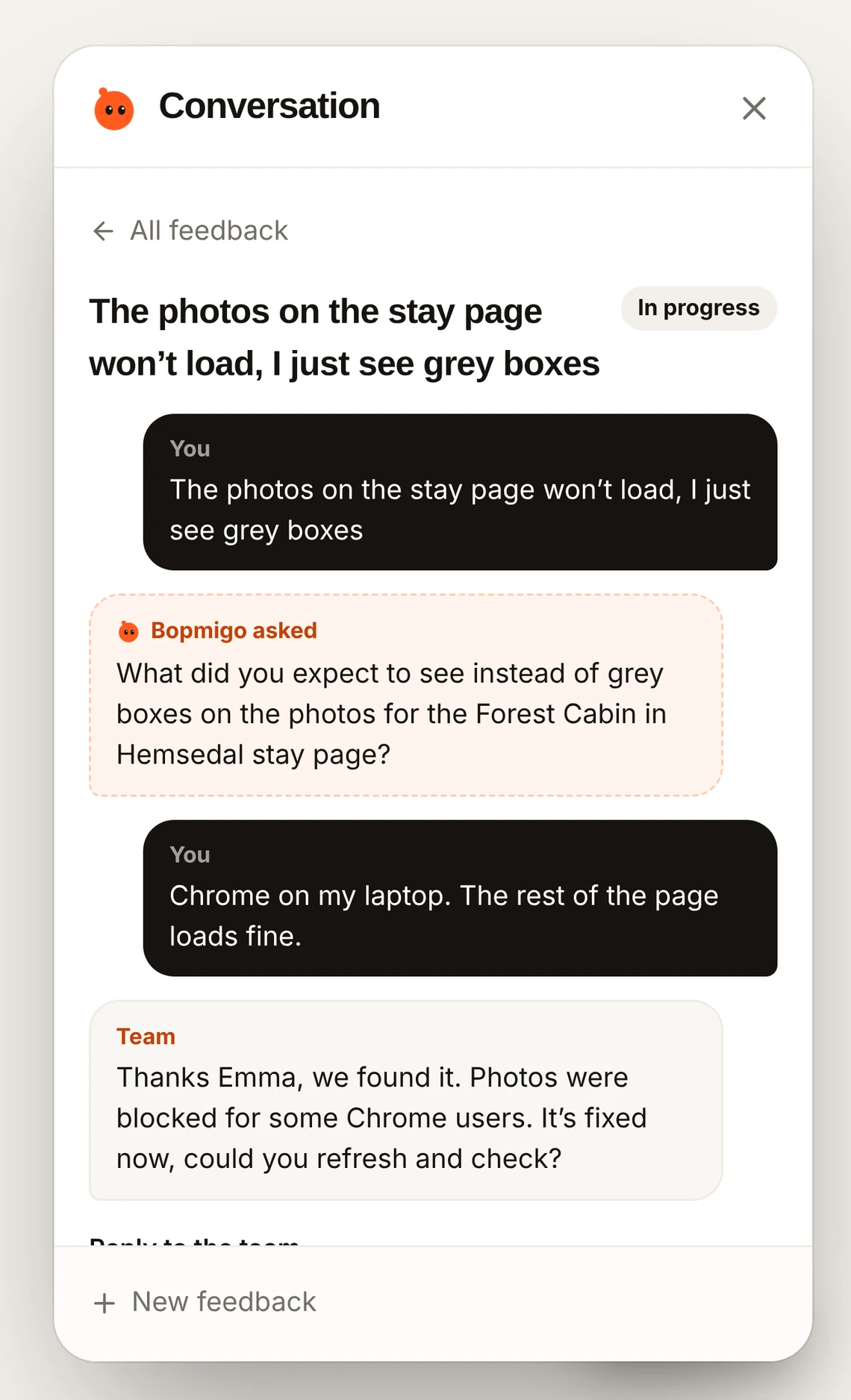
Bopmigo puts a Feedback option inside your web app or app, so trial users can tell you what’s confusing, broken or missing at the moment it happens, in a sentence. Each report includes the screen and device, and Bopmigo asks a short follow-up when something important is missing. Your reply reaches them where they asked, while they’re still deciding. If you pass in who is signed in, you know exactly which trial each report came from.
What’s a good trial-to-paid conversion rate?
It varies widely with price, audience and whether you ask for a card. Compare against your own numbers month to month rather than against someone else’s benchmark.
Should I require a card for the trial?
It changes who starts a trial more than whether the product is good. See card-required vs no-card free trials.
How long should my trial be?
Long enough to reach the main result once, with some room to spare. See how long a free trial should be.