Get your business ready for an AI agent: what to write down first
The information an AI agent needs to answer customers well: a checklist of facts, policies and limits, how to write them, a test set to check it, and how to keep it current.
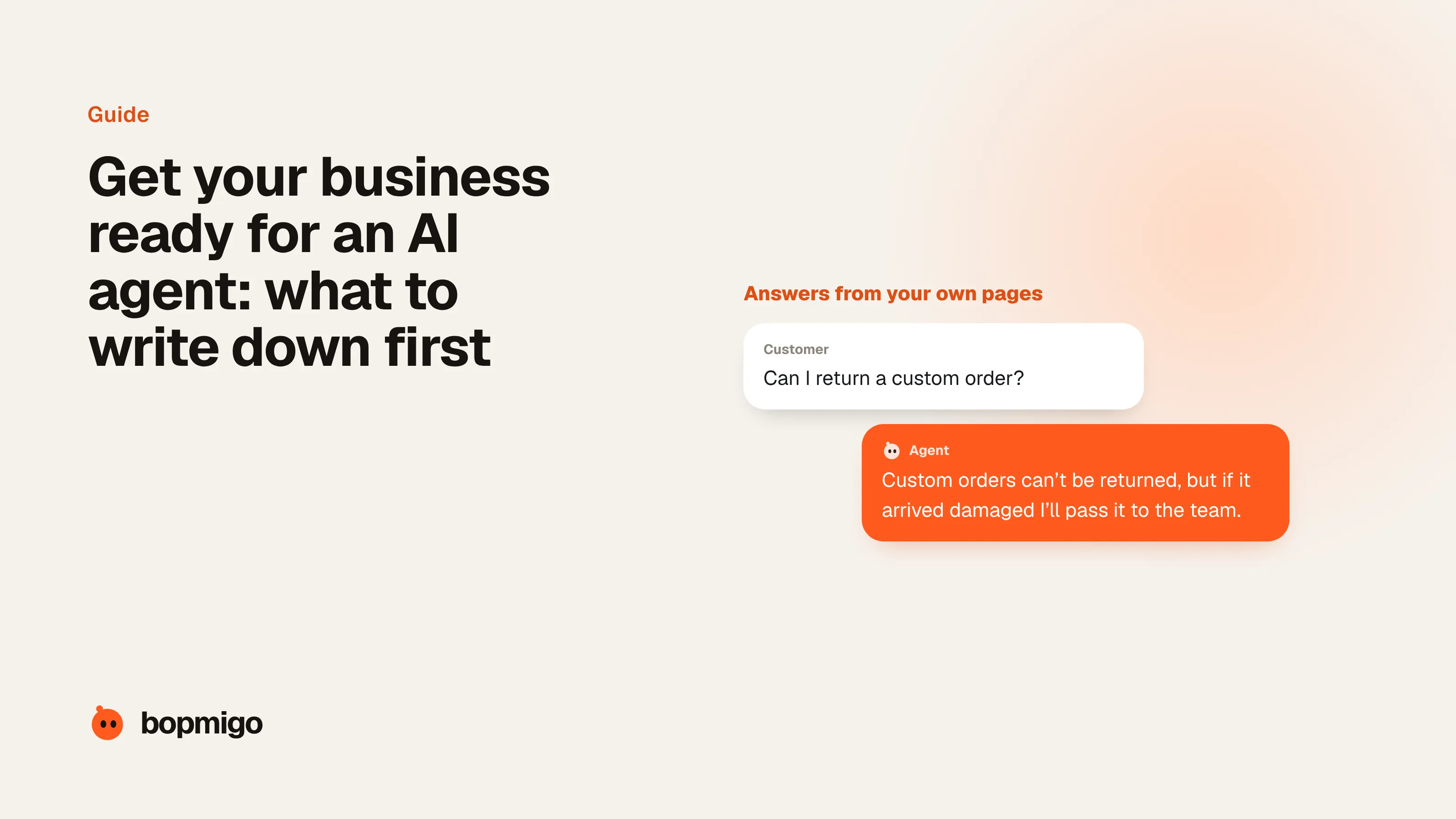
Short answer: an AI agent is only as good as what you give it. Before it talks to customers, write down five things: the facts customers ask about (prices, hours, delivery, how things work), your policies in full, what it must hand to a person, how you want it to sound, and 50 real questions to test it with. Most small businesses can do this in two or three days, and the same pages also help customers and search engines.
The five things to write down
| What | Examples | Where it usually lives |
|---|---|---|
| Facts customers ask about | Prices, plans, opening hours, delivery times, areas you cover, what’s included | Your website, pricing page, product pages |
| How-to answers | How to set up, change a booking, reset a password, return an item | Help pages, or your own head |
| Policies, in full | Refunds, cancellations, guarantees, privacy, shipping | Policy pages, terms |
| What it must hand over | Refunds outside policy, complaints, legal, medical, anything urgent | Nowhere yet: write it now |
| How it should sound | Friendly or formal, first names or not, words you never use | Nowhere yet: write a short note |
How to write answers an agent can use
- A single question per page or section, with the question as the heading. “How long does delivery take?” beats “Shipping information”.
- Answer first, then details. The first sentence should be the answer.
- Be specific. “Orders before 2 p.m. ship the same day” beats “we ship quickly”.
- Write the exceptions. “Except custom orders, which take 10 days.” Missing exceptions become wrong answers.
- Remove anything out of date. Old prices and old policies are the most common source of wrong answers.
- Keep it public where you can. Customers and search engines read the same pages, so you write once.
Write your hand-over list
Always hand to a person:
- Refunds or credits outside our 30-day policy
- Any complaint, or a customer who seems upset
- Anything about health, safety or legal matters
- Requests for discounts or custom terms
- Anyone who asks for a person
- Anything not covered by our help pages

When handing over, say: a person will reply by 10 a.m. the next working day.
Write a short voice note
We sound: warm, short, plain. First names. No exclamation marks.
We say: “orders”, “your account”, “the team”.
We never say: “unfortunately”, “as per our policy”, “dear customer”.
We never promise anything our policies don’t already say.
Build a test set
- 1
Collect 50 real questions
From your inbox, chat history, reviews and calls. Include the awkward ones.
- 2
Write the right answer for each
Or “hand over” where a person should take it.
- 3
Run them before launch, and after every big change
New prices, a new policy, a new product. Compare the agent’s answers with yours.
- 4
Fix the source, not the reply
When an answer is wrong, the information is usually missing or unclear. Fix the page.
Keep it current
- Give one person the job of keeping the information right.
- Update it the same day prices, hours or policies change.
- Read a sample of conversations every week and add any question it couldn’t answer.
- Re-run the test set every month.
Common questions
How long does it take to get ready?
For most small businesses, two or three days to gather and tidy the information, plus an afternoon to build a test set. It’s faster if you already have help pages.
Do I need a help center?
Not a formal one, but you need your answers written down somewhere the agent can read. Public help pages are best because customers and search engines use them too.
What if I don’t have written policies?
Write them before launch. An agent without a written refund policy will either refuse to answer or guess, and guessing is how businesses end up honouring promises they never made.
Sources
- American Bar Association: BC tribunal confirms companies remain liable for information provided by an AI chatbot (Moffatt v. Air Canada)
- Gartner survey: 64% of customers would prefer companies didn’t use AI for customer service (July 2024), as reported by CX Today
- Intercom Help: Understanding Fin outcomes