Users sign up and never come back: what usually went wrong
Lots of sign-ups, almost no second visits. The most common causes in the first session, how to find which one is yours, and how to ask the people who left.
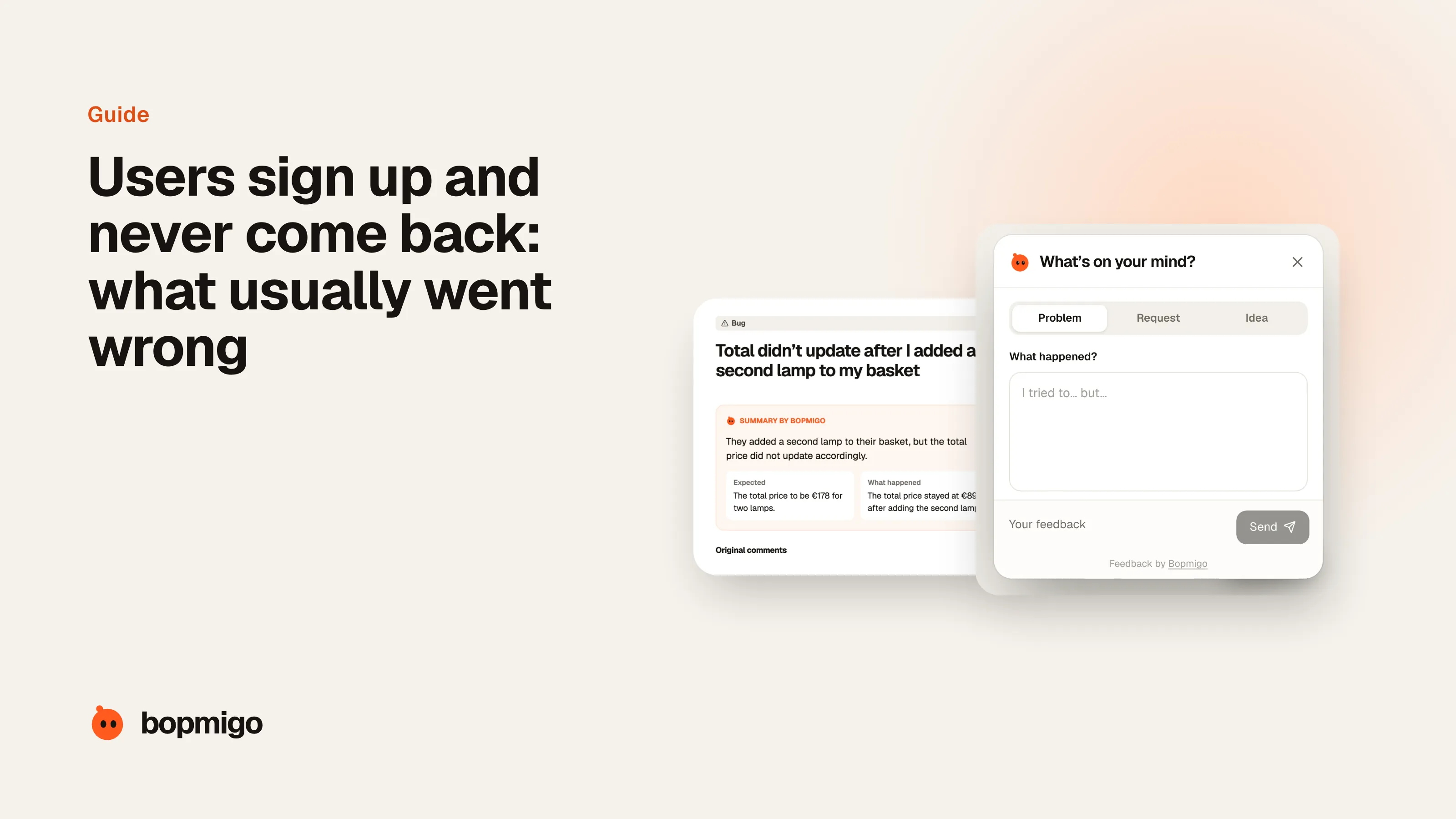
Short answer: most people who never return hit a problem in their first few minutes: they didn’t understand what to do, something didn’t work, setup asked too much, or the product didn’t do what the landing page promised. Find out which by watching where first sessions end, asking the people who just signed up while they’re still in the product, and emailing the ones who left within a day or two.
This shows up constantly in founder posts. We saw founders report hundreds of sign-ups and only a handful of active users, social launches that brought “129 sign-ups” but little use, and first-week numbers like “14 users, 0 active after week one”. The pattern is usually the same: getting people in the door worked; the first session didn’t.
The five usual causes
| Cause | What it looks like | How to check |
|---|---|---|
| Unclear first step | People land on an empty screen and leave | Watch a few first sessions, or ask “what did you expect to see?” |
| Something broke | An error, a blank page or a button that does nothing | Ask new users to report anything odd, and check error logs for first-day accounts |
| Too much setup | Long forms, imports or permissions before any value | Count the steps before someone gets their first result |
| Wrong promise | The product isn’t what the ad or landing page suggested | Compare what people searched or clicked with what they found |
| Wrong audience | People signed up out of curiosity, not need | Ask what they hoped to do, at sign-up or in a welcome email |
Find where first sessions end
Analytics tells you where people stop. Pick the three or four steps that matter in a first session (sign up, first action, first result, return visit) and see which step loses the most people. That’s where to look first. Analytics won’t tell you why, so pair it with asking.
Ask while they’re still there
- Keep a feedback option visible on every screen during the first session, so confusion becomes a sentence you can read instead of a closed tab.
- When an action fails, offer to send the problem to you right there.
- On the second visit, ask a single light question such as “Was anything confusing last time?”. People who came back are more willing to answer.
- Don’t put a survey in front of someone in their first minute. Let them try the product first.
Email the people who left
Within a day or two of a sign-up with no return visit, send a short plain-text email from a real person. No newsletter design, no links to ten features.
Subject: Did something get in the way?

Hi {first name},

You signed up for {product} on {day} but didn’t get much further.
Was something confusing or broken? A one-line reply helps a lot,
and I read every answer myself.

{your name}
Expect few replies, but read every one. A handful of honest answers usually points at the same problem.
Fix the first five minutes before anything else
- Get people to their first useful result with as few steps as you can.
- Replace empty screens with an example or a single clear next step.
- Delay anything that isn’t needed for the first result: profile details, team invites, integrations.
- Test the first session yourself on a phone and on a slow connection, every release.
A first-session audit you can do in an hour
- 1
Sign up as a stranger
Use a new email, a phone, and the link from your main traffic source. Note every screen until you reach something useful.
- 2
Count the asks
Every form field, permission, choice and confirmation is an ask. Write them down. Most first sessions ask for far more than they need.
- 3
Find the first useful moment
Mark the exact screen where a new user gets value. Everything before it is a place to lose people.
- 4
Remove or delay three asks
Pick three things that aren’t needed before the first useful moment and move them later.
- 5
Check what happens when things fail
Turn off Wi-Fi, enter something wrong, deny a permission. Does the product explain what happened and what to do?
What founders found when they asked
In the founder posts we read between September and November 2026, the reasons people gave once someone asked them were rarely about price or features. They were about the first few minutes: “I didn’t know what to do next”, “it asked me to connect my account and I didn’t want to”, “the page was empty”, “I thought it was something else”. Those are cheap to fix compared with building new features, but you only hear them if you ask.
What to measure after you change something
| Measure | Why it matters |
|---|---|
| Share of new users who reach the first useful moment | Tells you whether the first session works |
| Share who come back within a week | Tells you whether that moment was worth repeating |
| Reports and replies in the first session | Tells you what is still confusing |
| Time from sign-up to first useful moment | Shorter is almost always better |
Change one thing at a time and watch these for a week or two. With small numbers, be patient: a handful of users can swing the results.
Common mistakes when investigating
- Looking only at averages. Average time in app hides the large group who left after a minute. Look at how many first sessions end before the first useful moment.
- Asking everyone a long survey. A five-question survey to people who left gets almost no answers. A single plain question from a person gets a few honest ones.
- Fixing what loud users want. Your most active users are not the people who left. Their requests matter, but they won’t tell you why newcomers quit.
- Changing several things at once. If you redesign onboarding, move the paywall and change the pricing in the same week, you won’t know which helped.
More on this: how to improve Day 7 retention, how to improve social app retention and fixing retention before paying for growth.
Where Bopmigo fits
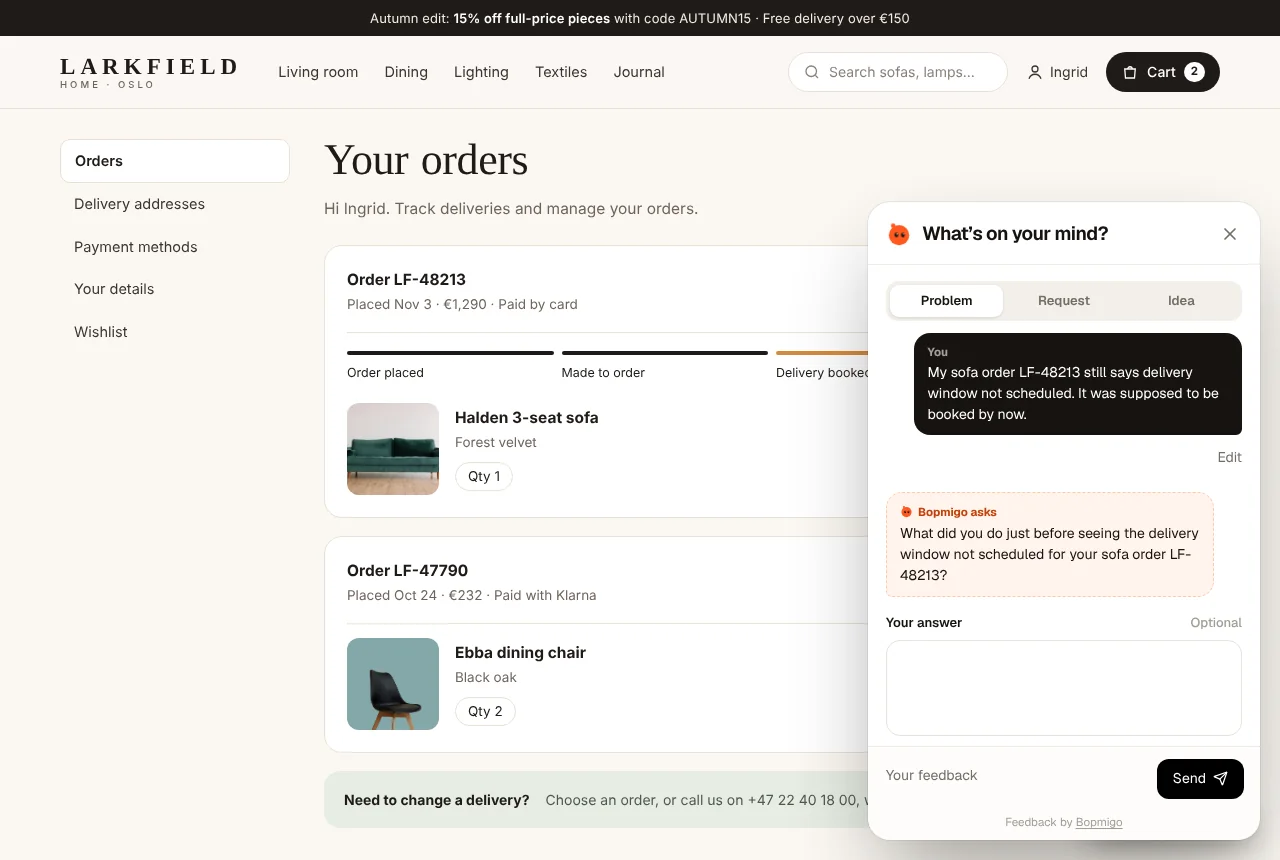
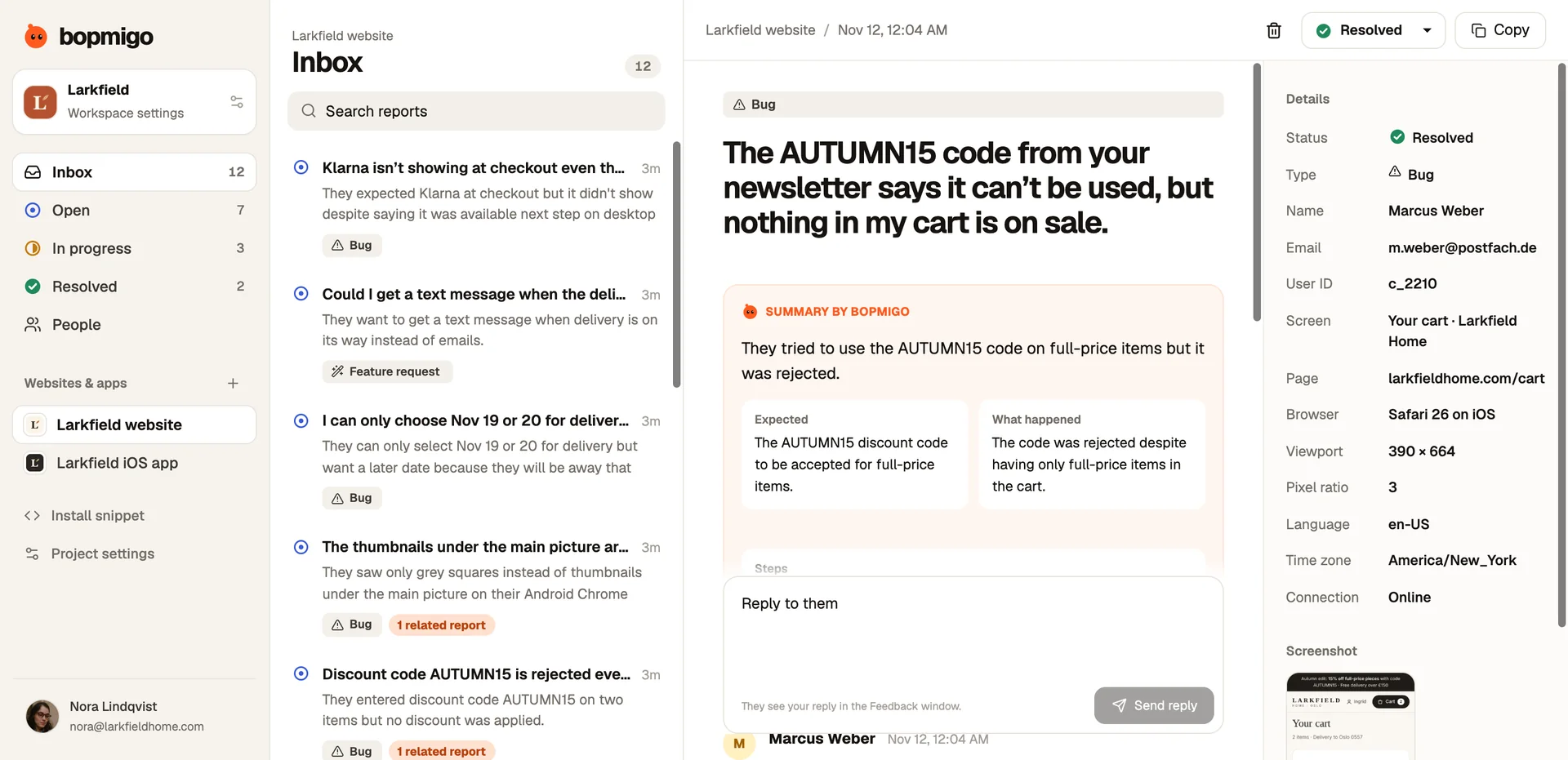
Bopmigo gives new users a way to tell you what went wrong in their first session, in a sentence, without leaving your site or app. Each report arrives with the screen they were on, their device and a screenshot, so “it didn’t work” becomes something you can reproduce. When a report is vague, Bopmigo asks a short follow-up for you, and your reply reaches them where they reported, often before they’ve given up.
How many sign-ups should come back?
It depends a lot on the product and how people found you. Track your own number week by week and judge changes against it, rather than against someone else’s benchmark.
Should I make sign-up harder to filter out tire kickers?
Sometimes asking a question at sign-up helps you learn intent. Making it harder rarely fixes a first session that loses people.